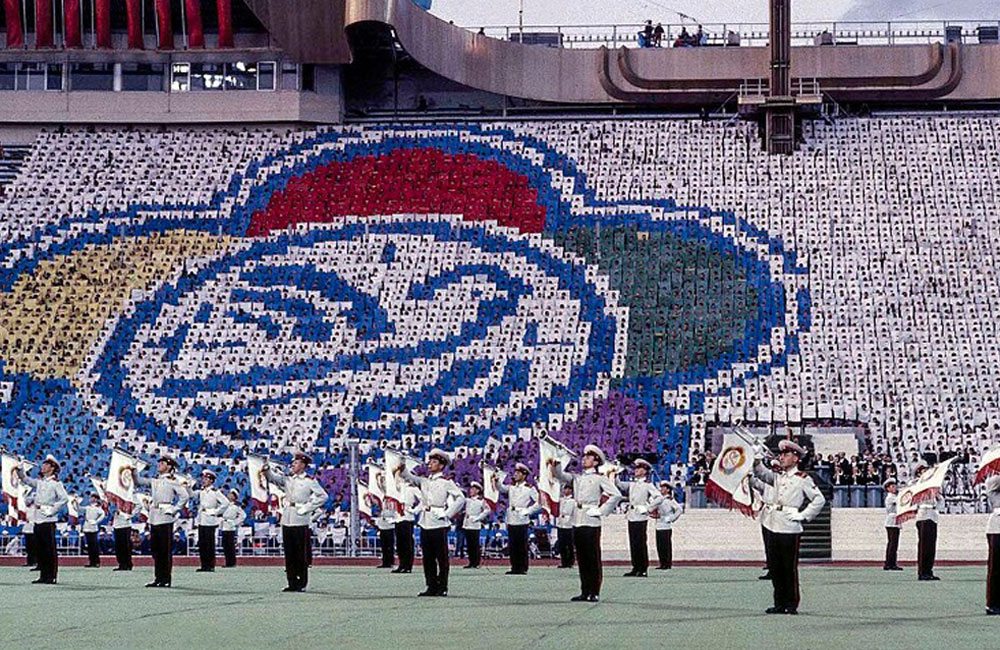
In the last week of July 1985, Moscow turned itself inside out for the 12th World Festival of Youth and Students, a Soviet-hosted event that, that year, drew roughly 26,000 delegates from 157 countries, the largest in the history of this festival. The opening ceremony at Lenin Stadium ran four hours: a sea of national costumes, card-stunt displays rippling across the stands, athletes and schoolchildren performing in massive coordinated formation, thousands of white doves released into the sky, the whole thing broadcast live on Soviet television.
Mikhail Gorbachev, five months into the job, gave the welcome address — tying the moment to the fortieth anniversary of the end of the Second World War and, as the novel’s own opening-ceremony scene captures, using the stage to announce a unilateral nuclear test moratorium that caught Washington off guard. For the rest of the week, an official program of concerts and ‘friendship’ events ran alongside something looser: thousands of foreign students mixing with their Soviet hosts in Moscow’s parks, courtyards, and student clubs, under watchful but not always effective supervision. Bob Dylan is documented as having played a short, informal set in Moscow just before the festival opened — though what exactly happened at that performance, and who else was there, is disputed; even people who claim to have been in the room don’t agree on the details.